

AI for Small Business: How It Saves Time and Increases Sales
Two years ago, a small business owner adopting AI was doing something unusual. That's no longer true. AI for small business has moved from a novelty to something close to table stakes, and the shift happened faster than most owners noticed happening.
What's less clear is what that actually means for a specific business: one person, a handful of staff, a full plate of things that need doing today. This isn't another list of AI tools to try. It's a look at where adoption actually stands, what changed to make it worth paying attention to now, and a simple way to decide where to start without wasting money on the wrong thing first.
Where small business AI adoption actually stands
The numbers moved quickly. The U.S. Chamber of Commerce's small business research shows adoption climbing from well under 40% just a few years ago to a clear majority of small businesses using AI in some form by 2026. A separate study from the JPMorganChase Institute, tracking real Chase Business Banking payment data since 2019 rather than survey responses, found the same acceleration, though it also noted that adoption isn't even: businesses further along tend to pull further ahead, while slower adopters risk falling behind on cost and service speed.
Two things are true at once here. AI for small business is no longer experimental. Most owners have tried something. And most of that trying is still shallow: a chatbot here, a writing tool there, nothing that's actually restructured how the business runs day to day. The gap between "has used AI" and "AI is doing real work" is where most of the opportunity still sits.
Why the barriers that used to block small businesses have fallen
For a long time, AI was genuinely out of reach for a small operation. It required data science expertise, custom infrastructure, and a budget that assumed dozens of employees, not one or two. That's the part that's actually changed.
AI business tools today are largely no-code, meaning you type what you want in plain language rather than writing scripts. They're embedded directly into software many businesses already use, rather than requiring a separate platform and integration project. And pricing has come down from enterprise contracts to monthly subscriptions that start in the single digits.
A three-person business now has access to categories of tooling that used to be exclusive to companies with dedicated technical teams. That's a real shift, not marketing language; it's the direct reason adoption numbers moved as fast as they did.
A Few Concrete Examples
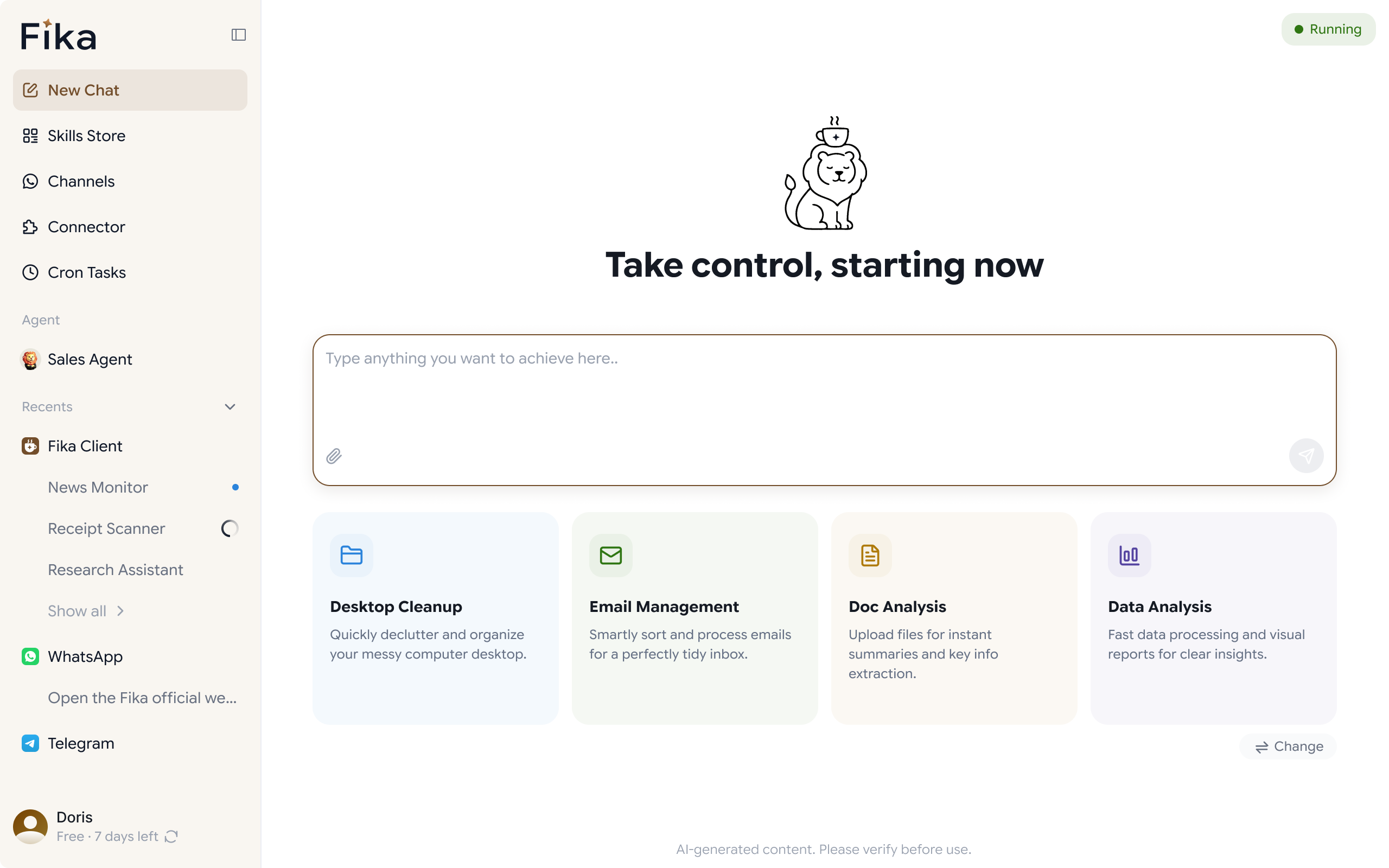
Abstract claims about "AI transforming small business" don't tell you much. Here's what it actually looks like in a few specific situations. A business owner used to start every morning by scrolling through the WhatsApp messages that came in overnight, replying to each one individually before doing anything else. With Fika's WhatsApp Sales Agent handling the routine ones, that 45-minute block is now a five-minute review of drafts that are mostly ready to send. The time didn't disappear into a system dashboard somewhere. It went back into the actual workday.
A retailer with a growing product catalogue used to write every product description from scratch. AI now generates a working first draft from a few key details, cutting a 20-minute task down to a few minutes of editing. Multiplied across 200 products, that's real time back.
A service business used to lose track of which leads had gone quiet, because there was no system tracking conversation activity, just memory, and memory doesn't scale past a certain number of open conversations. Automatic follow-up tracking catches what used to slip through, one of the clearer wins that shows up specifically in AI for sales: leads that would have gone cold get a second touch instead.
None of these are dramatic transformation. They're small, specific recoveries of time and attention, which, added up across a year, are where the actual value shows up.
The honest limits
It's worth being direct about what AI doesn't do. It won't make a pricing decision for you. It won't handle a genuinely upset customer with the judgment a real conversation needs. It won't build the relationship that turns a first-time buyer into a repeat one, but it can support that relationship by making sure nothing falls through the cracks. The relationship itself is still a human thing.
The businesses getting real value tend to be specific about what they're automating and honest about what still needs a person. The ones that don't see much return are usually the ones that adopted a tool without a clear problem it was solving.
A simple way to decide where to start
With so many categories of tools available, the risk is spending more time evaluating than actually using anything. A more useful approach: identify the single task consuming the most time that doesn't require your specific expertise, and start there.
For a lot of small businesses, that task is customer communication: replying to WhatsApp inquiries, tracking who's waiting on a follow-up, and keeping some record of what each customer has asked about. It's rarely the most interesting part of running a business, and it's often the part eating the most hours in a week.
Framed simply, this is AI productivity for business at its most direct: doing more of what already needs doing, with the same number of hours in the day. If that's the bottleneck you recognize, it's a reasonable place to start before evaluating anything broader.
FAQ
Is AI for small business actually affordable, or is that mostly marketing? Pricing has genuinely come down. Many tools relevant to a small business now start free or in the single digits per month, a different world from the enterprise contracts AI was associated with a few years ago. The cost that catches people off guard isn't usually the subscription; it's the time spent evaluating and setting up tools that don't end up getting used.
Do I need a different tool for every part of the business? Not necessarily, and trying to adopt several at once is a common reason adoption doesn't stick. Most small businesses see faster, clearer returns from solving one specific bottleneck well before expanding into a second area.
What's the realistic time investment to get started? For a well-scoped tool addressing a specific problem, most small business owners are functional within 15–30 minutes of setup. The tools that take longer than that to show value are usually solving a problem that wasn't clearly defined going in.
Getting started
If customer communication is where your time is going, Fika's WhatsApp Sales Agent handles it directly: reading incoming messages, drafting replies, tracking every conversation in a local CRM, and flagging follow-ups automatically. It runs on your desktop, connects to your existing WhatsApp, and stores everything locally rather than on an external server.