

Why Businesses need AI Assistants, not just Chatbots

Three terms get used almost interchangeably in most conversations about AI for business: chatbot, AI assistant, and AI agent. Search for an AI assistant for business and all three show up mixed together, often describing completely different kinds of tools. The confusion isn't just semantic. A business that buys a chatbot expecting agent-level capability, or invests in agent infrastructure for a job a simple chatbot would have handled, usually ends up frustrated with "AI" in general rather than realising it picked the wrong category.
Here's the actual distinction between AI assistant vs chatbot, and a straightforward way to tell which one a given job actually calls for.
What each term actually means
Chatbots are reactive and customer-facing. They handle structured, high-volume, predictable interactions: FAQs, order status lookups, appointment booking. They respond to what's asked and stop there. Fast to set up, narrow in what they can do.
AI assistants, in most current usage, are personal or internal productivity tools rather than customer-facing systems. They're often embedded directly into tools people already use, drafting emails, managing a schedule, summarising a document, helping one person or a small team move faster through their own work.
AI agents are built to complete an entire task end to end, not just respond to a query. An AI agent for business doesn't just answer a customer's question; it can also log the conversation, update a record, and trigger a follow-up, all without a person manually doing each step. This is the category most people actually mean when they say they want "an AI assistant, not a chatbot", they want something that finishes the job, not just replies to it.
Why "Not just a chatbot" usually means "We need an Agent"
This is the part that gets muddled in most vendor marketing. When a business says it's tired of its chatbot and wants an AI assistant instead, what it's usually describing, in the terms above, is agent-level behaviour: something that reads a real customer question, drafts a genuinely relevant response, and then does something with that interaction afterward, logging it, flagging a follow-up, updating a record, rather than treating the reply as the end of the job.
A chatbot alternative, in other words, isn't automatically "a smarter chatbot." It's frequently a different category of tool altogether, one built around completing work rather than just answering a message.
Where the confusion actually costs businesses
Buying a chatbot when the job needed an agent means routine questions get answered, but nothing else changes: no record gets kept, no follow-up gets triggered, and the business is back to doing the rest manually. Buying agent-level infrastructure for a job that only needed FAQ coverage means paying for and maintaining far more complexity than the problem justified.
A concrete version of this: a business installs a chatbot to handle WhatsApp inquiries, and it does answer the basic "what are your hours" and "do you deliver here" questions well enough. But a customer asking a specific product question still gets a generic reply, nothing gets logged about who asked what, and if that customer goes quiet for a few days, nobody notices. The chatbot did its narrow job. The actual problem, a business losing track of real customer conversations, was never addressed, because it was never a chatbot-shaped problem to begin with.
A commonly cited rule of thumb captures the split reasonably well: a chatbot can reasonably absorb the bulk of repetitive, structured questions a business receives, while the smaller share that actually drives outcomes, a real lead, a specific complaint, a conversation that needs follow-up, needs something closer to agent-level handling to not fall through the cracks.
Which one does your business need
Ask what happens after the question gets answered. If nothing needs to happen next, a chatbot is probably sufficient. If a record needs to be kept, a follow-up needs to be scheduled, or the conversation needs to lead somewhere, a chatbot alone won't cover it, regardless of how well it answers the initial question.
Ask who the tool is actually serving. A business AI assistant that drafts your emails and manages your calendar is solving a different problem than a business AI assistant that's supposed to handle inbound customer conversations start to finish. The second one is functionally an agent, even if it's marketed under the simpler label.
Where this leaves Fika
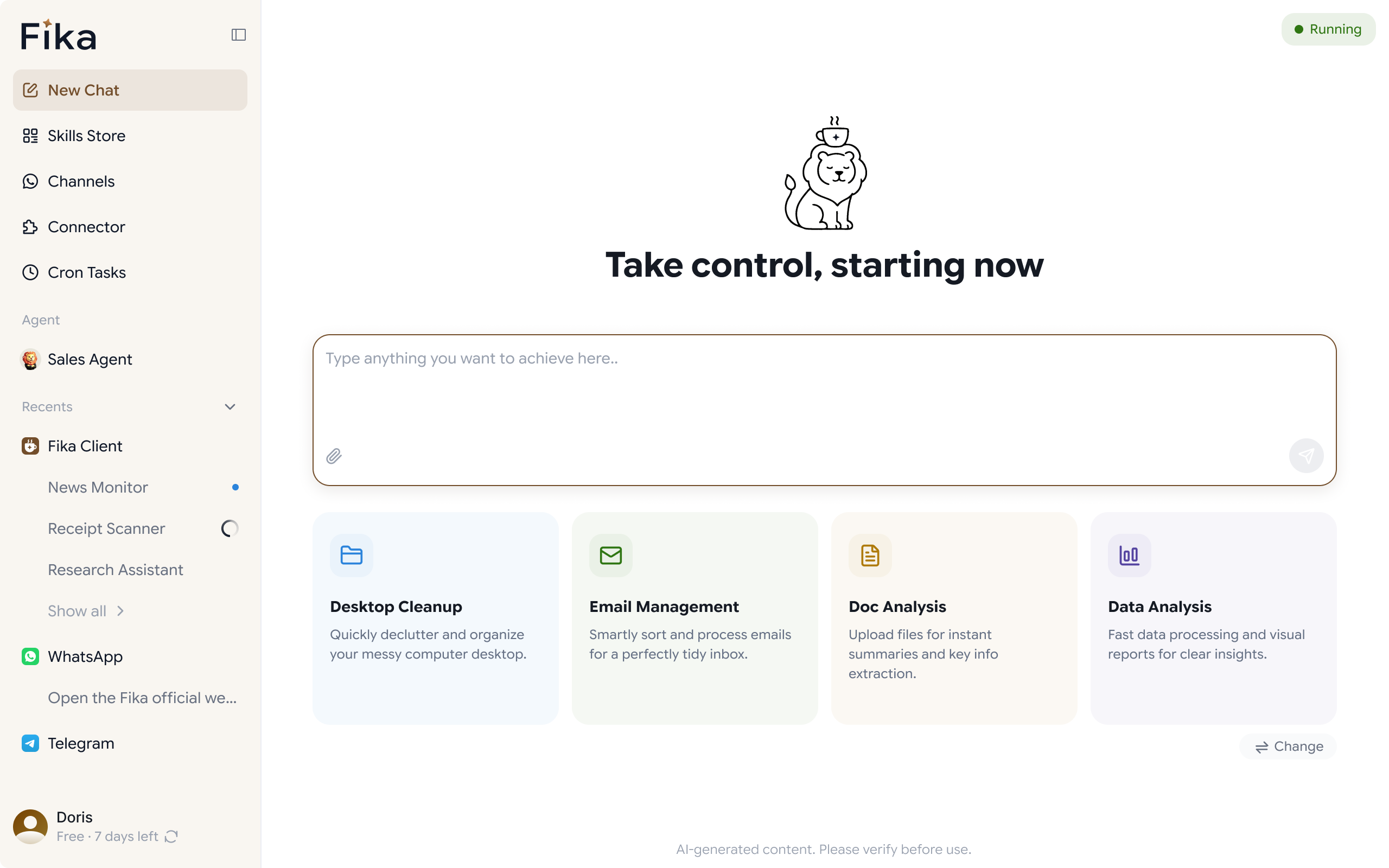
Fika's WhatsApp Sales Agent sits closer to the agent end of this spectrum than the term "assistant" alone might suggest. It doesn't just draft a reply to a customer message: it logs the conversation to a local customer record automatically, tracks whether the conversation has gone quiet, and prepares a follow-up without anyone remembering to do it manually. That's task completion, not just a smarter response.
Worth being upfront about this: the market doesn't always use "assistant" and "agent" with precision, Fika included in its own naming. What matters more than the label is whether a specific tool actually finishes the job it's handling or just answers the first question and stops there.
Getting Started
Try Fika free for 7 days. If your current chatbot answers questions but leaves everything else for you to do manually, that's usually the sign you need something closer to an agent than a chatbot alternative.
FAQ
Is an AI agent always the right choice over a chatbot? No. If your actual need is fast, accurate answers to a narrow set of predictable questions, a chatbot does that job well and costs less to set up and run.
Can one tool be both a chatbot and an agent? In practice, many tools blend the categories rather than sitting cleanly in one. What matters isn't which label a vendor uses, but whether the tool actually completes the task, logging, tracking, following up, or stops at the reply.
How do I know if my current chatbot is actually holding my business back? A reasonable test: if you're still manually tracking who messaged, what they asked, and whether anyone followed up, your chatbot is answering questions but not doing the rest of the job.