

Meta's Native WhatsApp Agent doesn't Replace Fika

Meta rolled out Business Agent globally in June 2026, giving every business on WhatsApp access to a native AI agent that answers questions, recommends products, books appointments, and qualifies leads without a human on the other end. For a lot of small businesses running sales through WhatsApp, that sounds like the automation problem is solved. It isn't, and the gap matters more the more seriously you're using WhatsApp to sell.
What Meta Business Agent handles
Meta built this for the conversations that start and end inside WhatsApp. Product questions, opening hours, order status, appointment booking. If a customer can be served entirely from information the agent already has, it replies instantly and the conversation closes there.
That's a real upgrade over having no automation at all, and for businesses with simple, repetitive WhatsApp traffic, it's a reasonable starting point. The problem shows up as soon as a conversation needs something outside WhatsApp itself.
Where it stops
It doesn't leave the conversation. Meta's agent replies inside the chat and that's the end of its job. It doesn't update a spreadsheet, log the lead anywhere, draft a follow-up email, or do anything with what it just learned about the customer. Someone still has to go do that manually, which means the automation only covers the reply, not the work the reply creates.
It's locked to Meta's apps. Business Agent works across WhatsApp, Messenger, and Instagram, and nowhere else. If your customers also reach you on Telegram or WeChat, or if a lead comes in through email and continues on WhatsApp, you're back to juggling separate tools and separate histories.
Your data lives in Meta's cloud. Every conversation, every piece of customer information the agent uses, sits on Meta's infrastructure. For businesses handling customer details, payment discussions, or anything sensitive over WhatsApp, that's a data residency question worth taking seriously, not a footnote.
It's billed per conversation. Meta introduced a dedicated pricing tier for AI-initiated conversations in 2026, and importantly, the free 24-hour customer-initiated window doesn't carry over to Business Agent replies. Run enough volume through it and the cost adds up in a way that's easy to miss until the invoice arrives.
What a business actually needs
Selling on WhatsApp isn't really a chat problem. It's an operations problem that happens to run through chat. A lead comes in, you reply, you need to remember what they asked last time, follow up if they go quiet, and eventually do something with that information outside the conversation entirely, whether that's booking it in a calendar, logging it as a deal, or handing it to whoever closes.
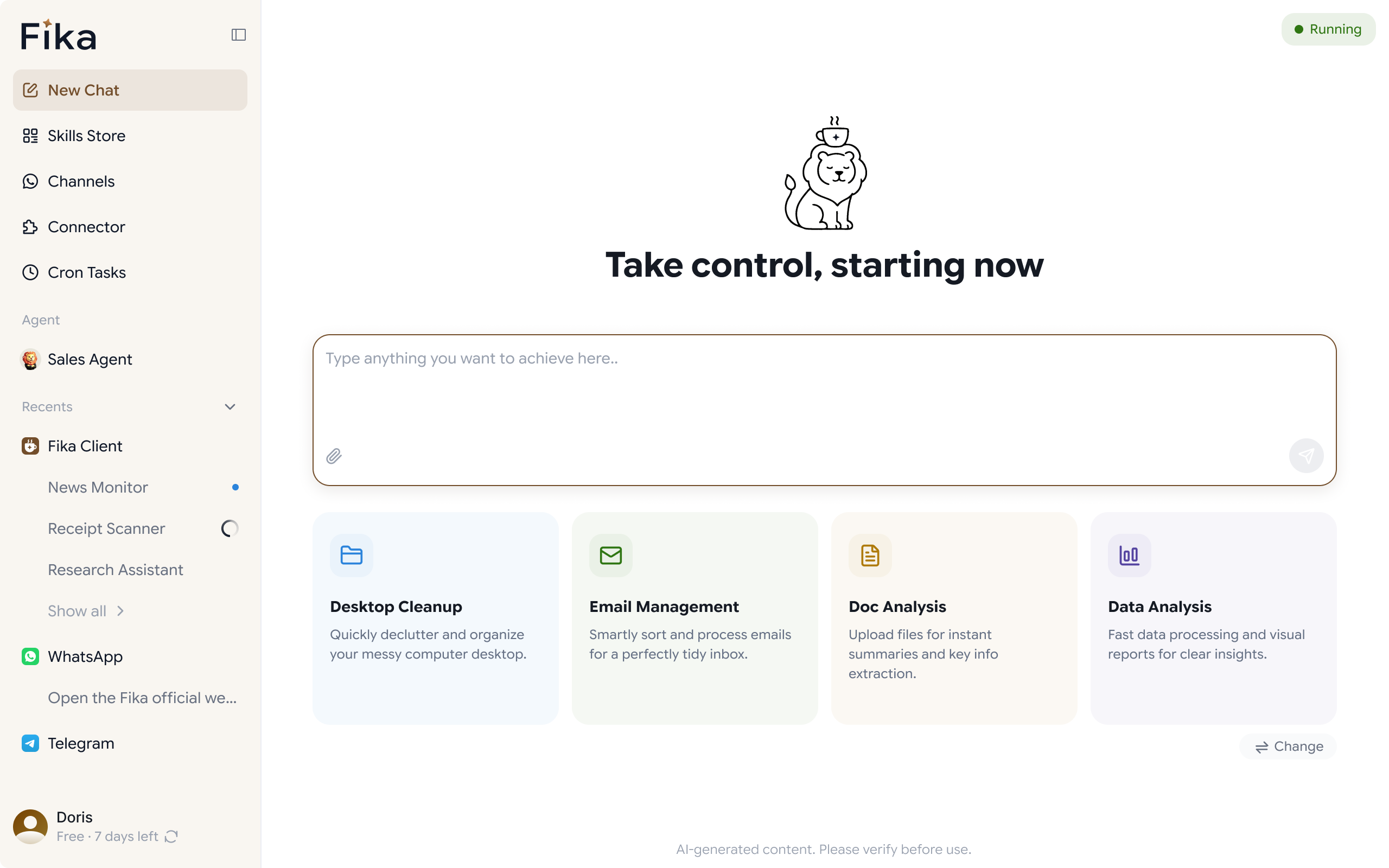
Fika is built around that whole loop instead of just the reply. The WhatsApp Agent inside Fika keeps a CRM of every customer conversation, sets follow-up reminders on its own, and replies in the customer's language automatically. But because it runs as part of a full desktop agent rather than a chat-only bot, it can also act on what happens in that conversation. It can pull a file, check something in your calendar, or move a task forward on your computer, the kind of follow-through that a chat-native tool was never built to do.
The channel question matters too. Fika connects WhatsApp, Telegram, and WeChat from the same place, so a business isn't stuck rebuilding the same setup for every platform its customers happen to use.
And on data, the difference is structural rather than a marketing line. Fika runs locally on the business's own computer. Conversations, customer history, and everything the agent learns stay on the device, not on a third party's servers. For any business that has to think about where customer data lives, that's not a small distinction.
Which one actually fits
If your WhatsApp traffic is genuinely simple, mostly FAQs, hours, and order status, Meta's Business Agent will do the job and it's already built into the platform you're using. There's no real case for adding another tool on top of it for that narrow use.
The moment your WhatsApp sales process involves remembering customers, following up without being reminded, working across more than one messaging app, or doing anything with a conversation after it ends, you're asking a chat responder to do a job it wasn't built for. That's the point where a dedicated agent built around the full sales workflow, not just the reply, earns its place.