

What Is a Conversational AI Chatbot?
Conversational AI Chatbot: How It Works, Benefits, and Real Business Examples
Customers expect businesses to respond quickly, whether they're visiting a website or sending a message on WhatsApp. While traditional chatbots helped automate simple conversations, they often struggled to understand what customers were actually asking. That's where a conversational AI chatbot makes a difference.
Unlike rule-based chatbots that rely on predefined scripts, a conversational AI chatbot uses artificial intelligence to understand natural language, recognize user intent, remember context, and generate responses that feel human. Instead of forcing customers to follow a rigid conversation flow, it adapts to how people naturally communicate.
Today, conversational AI is helping businesses automate customer support, answer product questions, qualify leads, schedule appointments, and provide personalized assistance across multiple channels.
What Is a Conversational AI Chatbot?
A conversational AI chatbot is an AI-powered application that communicates with users through natural language. It combines technologies such as Natural Language Processing (NLP), machine learning, and large language models (LLMs) to understand questions, interpret intent, and generate meaningful responses.
For example, if a customer asks:
"Do you deliver outside Nairobi?"
The chatbot understands the customer's intent instead of simply looking for keywords. If the customer then asks:
"How much does it cost?"
It understands that the question refers to delivery and continues the conversation naturally without asking the customer to repeat themselves. This ability to understand context is what separates conversational AI from traditional chatbots.
How does a Conversational AI Chatbot work?
Every conversation follows a simple process. First, a customer sends a message through a website, mobile app, or messaging platform like WhatsApp. The chatbot then uses Natural Language Processing to understand what the customer means rather than matching exact words. It identifies the user's intent, extracts important details, and considers the context of the conversation.
Next, the AI generates an appropriate response using its knowledge base, connected business systems, or company information. Modern conversational AI doesn't simply choose from a list of predefined replies. Instead, it generates responses that feel natural while remaining accurate.
Finally, the chatbot remembers the conversation. If a customer asks a follow-up question, it understands the context and responds accordingly, creating an experience that feels much more like talking to a person.
Conversational AI chatbot vs Traditional chatbot
Although people often use the terms interchangeably, they are different. Traditional chatbots follow predefined rules and scripted conversation paths. They work well for simple tasks like answering business hours or directing customers to a specific page. A conversational AI chatbot goes much further. It understands different ways people ask the same question, maintains context throughout the conversation, adapts its responses, and handles more complex requests. This creates more engaging customer interactions while reducing frustration.
Benefits of a Conversational AI Chatbot
Businesses are adopting conversational AI because it improves both customer experience and operational efficiency.
- Instant responses at any time of day, reducing waiting times and improving satisfaction. Support teams spend less time answering repetitive questions, allowing them to focus on more complex issues.
- Helps businesses increase sales by answering product questions, recommending relevant products, and guiding customers through the buying process. Because every customer receives consistent information, businesses can maintain a higher level of service while reducing human error.
- Scalability. Whether a business receives 50 conversations or 50,000, conversational AI can handle multiple interactions simultaneously without increasing staffing requirements.
Real-World applications
Conversational AI is transforming customer communication across many industries. Online stores use conversational AI chatbots to recommend products, answer shipping questions, provide order updates, and support customers throughout the purchasing journey.
Healthcare providers use conversational AI to schedule appointments, answer common patient questions, and reduce administrative workloads.
Banks assist customers with account information, card services, and frequently asked questions while educational institutions use conversational AI to guide prospective students through admissions and course inquiries.
Travel companies automate booking support, itinerary updates, and customer assistance, helping travelers receive immediate answers whenever they need them.
Conversational AI on WhatsApp
WhatsApp has become one of the most important communication channels for businesses. Instead of asking customers to visit a website or install another app, businesses can engage them where conversations already happen. Imagine a customer sending a message asking:
"Do you have this product in stock?"
A conversational AI solution can understand the request, answer the question, respond to follow-up messages, and continue the conversation naturally. As AI technology advances, many businesses are moving beyond traditional chatbots toward AI agents that combine conversational intelligence with the ability to access business knowledge and support more complex tasks.
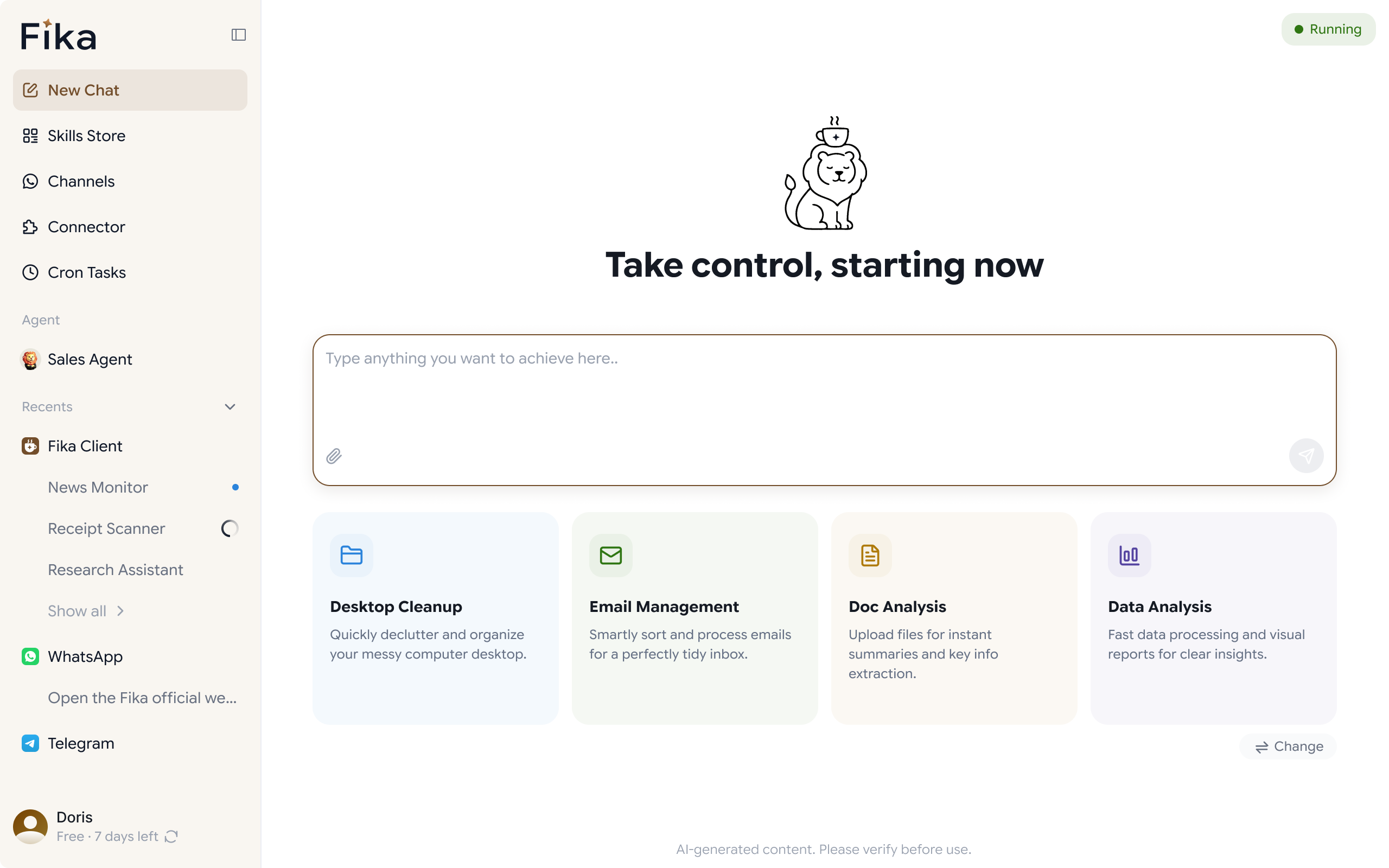
For businesses that rely on WhatsApp, FIKA's WhatsApp Agent brings these capabilities into a familiar messaging experience. Rather than functioning as a traditional chatbot, it acts as an AI agent that understands customer requests, maintains context, and helps businesses automate customer interactions with faster and more personalized responses.
Conversational AI Chatbots vs AI Agents
Conversational AI chatbots are designed to understand conversations and respond naturally. AI agents build on those capabilities by reasoning through tasks, using business knowledge, and interacting with connected systems to provide more intelligent assistance. For example, if a customer asks about an order, a conversational AI chatbot can answer based on available information. An AI agent can go further by retrieving the latest order details, checking delivery status, and presenting updated information during the same conversation. This makes AI agents particularly valuable for businesses looking to automate not only conversations but also parts of their daily workflows.
Choosing the right Conversational AI Solution
When evaluating conversational AI platforms, look for solutions that understand natural language, remember conversation history, integrate with your existing business systems, and are easy to manage as your business grows.
If your customers primarily communicate through WhatsApp, it's worth considering a solution designed specifically for that channel. FIKA's WhatsApp Agent helps businesses deliver intelligent, context-aware conversations on WhatsApp while combining the strengths of conversational AI with advanced AI agent capabilities.
Final Thoughts
A conversational AI chatbot has become an essential tool for businesses that want to improve customer support, automate repetitive conversations, and deliver faster, more personalized experiences.
As customer expectations continue to evolve, businesses are increasingly adopting AI agents that can do more than answer questions. They can understand context, access business information, and help complete meaningful tasks.
Whether you're supporting customers, generating leads, or improving response times, conversational AI can help your business communicate more efficiently. And for businesses focused on WhatsApp, solutions like FIKA's WhatsApp Agent provide a practical way to deliver intelligent, always-available customer experiences while taking advantage of the latest advances in AI.