

AI for Customer Communication: Types and Tools

What Is AI for Customer Communication? A Practical Guide
Search "AI for customer communication," and you'll land on pages built by companies like Aircall, Intercom, and HubSpot. These are platforms built for support and sales teams juggling phone lines, email queues, live chat widgets, and a CRM, often across dozens of agents. That's a real category, and a real problem. It's also not the whole picture, because a huge number of businesses in Africa communicate with customers through exactly one channel, and don't need (or want to pay for) the rest of that stack.
What "AI for Customer Communication" Actually Covers
The term is a category that spans several genuinely different jobs: answering a phone call, replying to a live chat message, responding to an email, and handling a WhatsApp or SMS conversation. Each of those channels has its own tools, and increasingly, each has its own AI layer sitting inside it.
What ties the category together is the function: reading or hearing what a customer is asking, understanding the intent, and either responding automatically or helping a human respond faster and more consistently than they could unassisted.
Types of AI Customer Communication Tools
- AI Voice and Call Tools
Platforms like Aircall sit on top of a business phone line and add AI features to the call itself: transcription, call scoring, automatic logging of what was discussed, and increasingly, AI agents that can look up a customer's record or open a support ticket mid-call without an agent doing it manually. This category matters most for businesses where a meaningful share of customer contact still happens by phone.
- Omnichannel Support and Messaging Platforms
Intercom is the clearest example here: a messaging-first platform built around a chat widget that lives on a website or inside a product, with an AI agent (Fin) that can resolve support conversations on its own. It's genuinely capable, but it's priced per resolution, which means costs scale directly with how many conversations the AI handles, not a flat monthly fee.
- Unified CRM-Based Service Hubs
HubSpot represents a different approach: AI communication features built into a broader suite that also covers marketing and sales, all sharing one customer database. The appeal is a single system instead of several disconnected tools. The trade-off is that the more useful AI features are often gated behind higher-priced plans, and the platform is doing a lot more than just customer communication.
- Channel-Specific AI Reply Assistants
The fourth category is narrower by design: tools built around one specific channel rather than a whole communication stack. Fika's WhatsApp Sales Agent is an example of this, an AI reply assistant built specifically for businesses where WhatsApp is the primary or only channel customers actually use, rather than a general omnichannel platform.
The Human-in-the-Loop Principle
Across every category above, the pattern holds: the more mature AI customer service tools get, the more they're built around a human still being in the loop, not fully replaced by it. AI drafts a reply or resolves a routine question; a person reviews, adjusts, or steps in for anything sensitive, unusual, or high-stakes. The businesses that get burned by AI communication tools are usually the ones that let a system run fully unsupervised on conversations that need judgment.
This shows up in different forms depending on the tool. Some let you review every AI-drafted reply before it sends. Others auto-resolve routine queries but escalate anything the AI isn't confident about. The specific mechanism varies, but the underlying idea (AI handles volume and repetition, a person handles nuance) is close to universal across the category.
Matching the Tool to Your Actual Communication Footprint
The honest answer to "which AI customer communication tool should I use" depends entirely on how many channels your business actually uses, and at what volume.
If your business genuinely spans phone support, email, live chat, and social messaging at meaningful volume, an omnichannel platform earns its cost. Paying for a unified system beats stitching together four separate tools and losing context every time a conversation moves channels.
If your communication is concentrated on one channel, the calculation changes. A business that gets the vast majority of its customer messages through WhatsApp doesn't need a platform built to also handle phone queues and email tickets. What it needs is a genuinely good AI reply assistant for that one channel: something that reads real customer messages, drafts contextual replies, tracks conversations, and manages follow-ups, without the overhead of an enterprise platform built for a different shape of business.
Neither approach is more "advanced" than the other. They're built for different volumes and different channel mixes, and tools built for enterprise support teams aren't automatically the better fit for a two-person business than a focused tool is.
Signs Your Business Is Ready for AI in Customer Communication
A few patterns show up consistently in businesses that get real value from adding AI to their messaging, rather than just adding another subscription they'll stop using in a month.
- Messages pile up outside business hours, and customers wait until morning for a reply that could have gone out in minutes.
- The same handful of questions get typed out fresh, by hand, dozens of times a week.
- A lead goes quiet mid-conversation and nobody follows up, because no one is tracking who still needs a nudge.
- One or two people are the only ones who know how to respond "on brand," so replies slow down whenever they're unavailable.
- Inquiries or order volume has grown faster than the team answering them.
None of these on their own mean a business needs an enterprise platform. Most mean it needs a tool that handles its one busiest channel well, which is usually the faster and cheaper problem to solve first.
Where Fika Fits
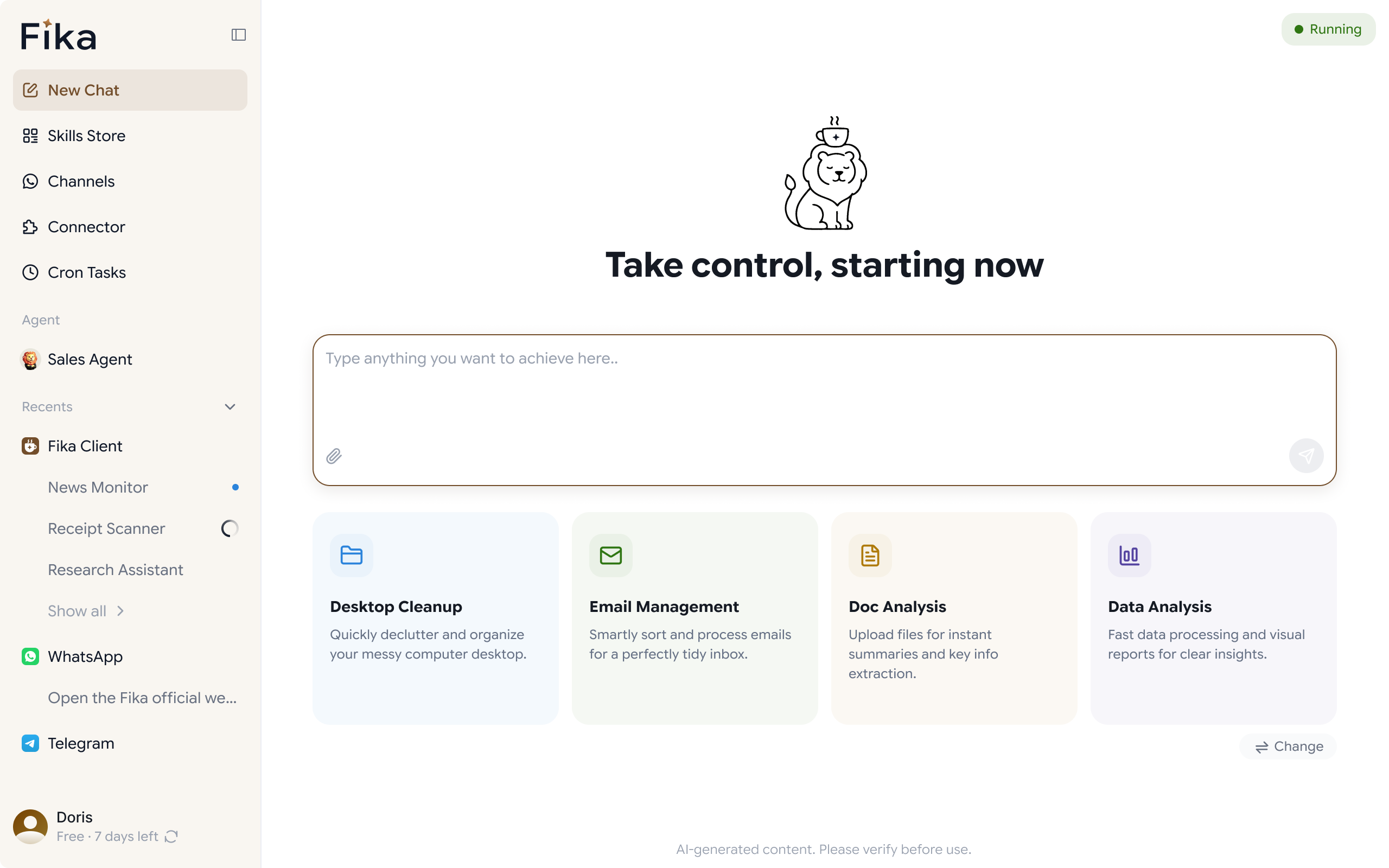
Fika's WhatsApp Sales Agent is built for the second scenario above: businesses where WhatsApp carries most or all of the customer conversation. It reads incoming messages, drafts contextual replies, keeps a record of every customer conversation, and flags follow-ups automatically when a conversation goes quiet. AI customer messages are handled from a single desktop app, without the setup or cost of a broader communication platform.
It won't replace an omnichannel platform for a business that genuinely needs phone, email, and chat unified in one place. For a business where WhatsApp is the channel that matters, it's a more direct fit than tools built for a wider stack.